The Exercise That Beats a Run for Blood Pressure
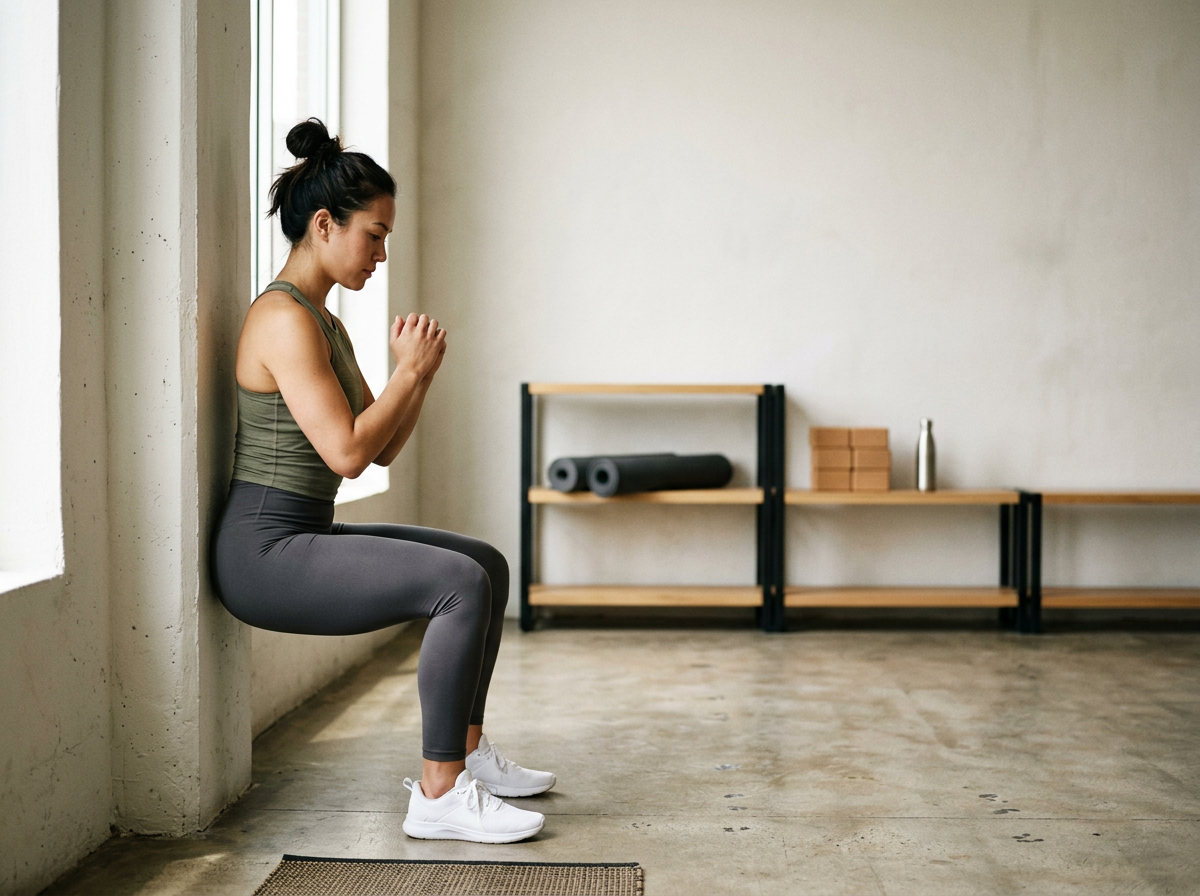
Wall Sit
A 2023 analysis of 270 randomized trials found that holding still — especially in a wall squat — lowered resting blood pressure more than running, lifting, or intervals. The mechanism is real. The protocol is almost embarrassingly small. Here is what the data actually supports.
Adapted from Thomas DeLauer, “This Exercise is Literally Better than HIIT for Lowering Blood Pressure (and dropping glucose),” October 2, 2026: https://youtu.be/ep-I8rRNXL4. The published trial numbers were checked against the papers; a few claims in the video are narrowed here.
If someone told you a single type of exercise lowered blood pressure more than running, cycling, ordinary lifting, and high-intensity intervals, the reasonable response would be skepticism. Exercise headlines are a competitive sport. Most of them collapse once you look at the sample size.
This one does not collapse. In July 2023, Jamie Edwards and colleagues published a pairwise and network meta-analysis in the British Journal of Sports Medicine. They pooled 270 randomized controlled trials and 15,827 people, and ranked every major training mode on resting blood pressure. All of them worked. Isometric training worked best.
What the head-to-head actually found
Isometric exercise is a muscle contraction without movement. A wall sit. A plank. A hand squeezed around a gripper and held. Blood is briefly squeezed out of the working muscle, then rushes back when you let go.
Across the trials, the average drops in resting blood pressure looked like this:
Training mode
Systolic
Diastolic
Isometric (wall sits, planks, handgrip)
−8.24 mmHg
−4.00 mmHg
Combined aerobic + resistance
−6.04
−2.54
Dynamic resistance training
−4.55
−3.04
Aerobic (walking, running, cycling)
−4.49
−2.53
High-intensity interval training
−4.08
−2.50
On systolic pressure, isometric training ranked first, with a 98% probability of being the most effective mode. Combined training was second. HIIT, the one people suffer through, landed last of the five.
A secondary analysis asked which specific exercise looked best. Wall squats ranked first for systolic pressure. Running ranked first for diastolic pressure. So the honest version of the headline is narrower than the video version: wall sits are the standout for the top number. They are not the winner of every blood-pressure contest ever run.
A few points matter. In a Lancet analysis of blood-pressure treatment trials, a 5 mmHg drop in systolic pressure was linked to about a 10% lower risk of major cardiovascular events — roughly 13% for stroke, 13% for heart failure, and 8% for ischemic heart disease. An 8 mmHg isometric effect is in the range of a single blood-pressure drug. It is not a reason to stop a drug a clinician prescribed.
Why holding still outperforms moving
During a hard wall sit, the quads and glutes stay contracted. That pressure compresses the small vessels inside the muscle. Flow drops. Metabolites build. When you stand up, blood floods back in. That squeeze-and-release is a strong signal for nitric oxide, the gas that tells vessel walls to relax.
Repeat the signal often enough and the vessels adapt. Resting tone falls. Some of the longer-term benefit is also thought to come from new capillary growth — more lanes on the highway, less pressure in each one. Aerobic work produces nitric oxide too. Isometrics seem to produce a sharper occlusion-reperfusion pulse, which is a plausible reason they punch above their time cost.
One practical detail the trials keep returning to: you do not need an hour. A 2023 multicenter trial in the Journal of Clinical Hypertension enrolled 77 adults with high blood pressure who were not on medication. Three sessions a week of wall squats cut systolic pressure by 12.9 mmHg. Handgrip training cut it by 11.2 mmHg. Controls barely moved. The initial block took about 42 minutes of training in total. A single weekly session — about 12 minutes — held the benefit.
The after-meal version is a different job
Blood pressure is the claim with the large evidence base. Glucose is the interesting extrapolation.
When a muscle contracts, it does not have to wait for insulin. Contraction activates AMPK, an energy sensor. AMPK helps move GLUT4 transporters to the cell membrane. Glucose leaves the blood and enters the muscle through a door insulin did not have to open. That is the same reason a walk after dinner flattens the glucose curve. It is also why people with insulin resistance still clear glucose when they move, even if their insulin signal is blunted.
A wall sit aims the effect at the largest muscles you own — quads, glutes, calves — and holds them on, instead of cycling them the way a step does. Matched for total work, moderate and hard contractions raise GLUT4 to a similar degree. Duration of contraction matters more than heroics.
What we do not yet have is a large head-to-head trial showing that a two-minute wall sit after pasta beats a ten-minute walk. The mechanism says both should help, and that stacking them is reasonable: sit the wall, then walk the block. Treat the post-meal wall sit as a practical add-on, not as a proven replacement for the walk.
Four protocols, ranked by what they are for
1. Blood pressure: the wall sit, three times, then once
Back flat to a wall, feet a step and a half out, slide until the thighs are near parallel. If the knees complain, stay higher. Pain is a stop, not a target.
Build toward four holds of 2 minutes, with 1–2 minutes of easy standing between them. Start at 20–40 seconds if that is honest.
Breathe. A held breath is a Valsalva, and that spikes pressure during the set. Nose in, mouth out, ribs soft.
Do this 3 days a week for 2–4 weeks, then once a week to keep the adaptation. Total work time is on the order of 8–14 minutes a session.
2. After a carb-heavy meal: one hold in the glucose window
About 15–30 minutes after the highest-carb meal of the day, do a single wall sit of 1–2 minutes, or two holds of 45–60 seconds.
If you can walk afterward, do. The sit recruits a lot of muscle at once. The walk keeps blood moving and repeats the signal.
This is a curve-flattener, not a license to ignore the meal.
3. At a desk: handgrip, 30 percent, four holds
The protocol used in most handgrip trials, and the one the American Heart Association has described: four 2-minute squeezes at 30–40% of your max, 1 minute of rest between, 3 days a week, for at least 8 weeks.
Find the max once: squeeze a gripper or a rolled towel as hard as you can. Train at about a third of that. Shaking and breath-holding means you are too high.
Alternate hands, or do the studied unilateral version. A 2025 meta-analysis of 31 trials put the average systolic drop around 5 mmHg, larger in people who already had hypertension. Useful. Not quite the wall sit.
4. A longevity proxy, not a promise: the dead hang
Grip strength predicts all-cause and cardiovascular death in large cohorts. It is a proxy for whole-body muscle, nervous system, and illness — not a spell. Squeezing a gripper improves the proxy a little. Hanging from a bar is closer to the capacity those studies are pointing at: can you support your body.
Start with 10–15 seconds, shoulders active rather than dumped into the joints. Add time before you add drama. A minute is a fine long-term mark for many adults.
Skip this if you have an acute shoulder injury, uncontrolled high blood pressure, or you cannot step down safely. A farmer carry or a towel hang from a sturdy door (that you trust) is a workable substitute.
What this does not replace
Isometrics won a blood-pressure ranking. They did not win fitness. Running still looked best for diastolic pressure in that same network. Walking still carries glucose, mood, bone loading, and the simple fact of being outside. Lifting still builds the muscle that grip strength is merely reporting on. A wall sit is a high-yield insert, about ten minutes a week once you are adapted. It is a poor substitute for a life that also moves.
Two safety notes, because the hold itself raises pressure while you are in it. The benefit shows up in resting pressure over days and weeks, not during the set. If your resting pressure is very high and untreated, if you have retinopathy, an aneurysm, or a recent cardiac event, ask before you turn a wall into a training partner. Knees that already hate deep flexion can do a higher sit and still get the vascular effect. The thigh does not have to be parallel on day one.
The useful reframe is dose. People abandon blood-pressure exercise because the prescription sounds like more cardio they already do not do. The trial that produced a 13-point systolic drop in unmedicated hypertension asked for less than an hour to get there, and twelve minutes a week to stay. That is a different conversation with a wall.
Sources
This article is adapted from Thomas DeLauer’s video “This Exercise is Literally Better than HIIT for Lowering Blood Pressure (and dropping glucose),” published October 2, 2026: https://youtu.be/ep-I8rRNXL4
Edwards JJ, et al. Exercise training and resting blood pressure: a large-scale pairwise and network meta-analysis of randomised controlled trials. British Journal of Sports Medicine. 2023;57:1317–1326. 270 trials, 15,827 participants. Isometric −8.24/−4.00 mmHg; wall squat ranked first for systolic pressure.
Cohen DD, et al. Reductions in systolic blood pressure achieved by hypertensives with three isometric training sessions per week are maintained with a single session per week. Journal of Clinical Hypertension. 2023;25:380–387. Wall squat −12.9 mmHg, handgrip −11.2 mmHg, in 77 unmedicated adults.
Blood Pressure Lowering Treatment Trialists’ Collaboration. Pharmacological blood pressure lowering for primary and secondary prevention of cardiovascular disease across different levels of blood pressure. Lancet. 2021;397:1625–1636. A 5 mmHg systolic reduction, about 10% fewer major cardiovascular events.
American Heart Association description of isometric handgrip: four 2-minute contractions at 30–40% of maximal voluntary contraction, 1 minute rest, three times weekly for 8–10 weeks.
Dose-response reviews of isometric handgrip, including a 2025 meta-analysis of 31 studies (about −5.4 mmHg systolic). Efforts under 30% did less; more than three sessions a week was not clearly better.
Educational, not medical advice. These are group averages from trials, not a prediction for any one person. Do not change medication on the basis of a wall.