What a year-long exercise program suggested about strength, walking, and progress after 70.
This post draws on a University of Jyväskylä study led by Onni Hämäläinen, Sarianna Sipilä, and colleagues, and published in 2026 in the European Journal of Applied Physiology. The full paper is open access.

Why This Is Important
If you have been showing up for class, taking walks, or doing a little strength work at home, and you are not sure it is "working," this study may feel like a relief.
Researchers in Finland followed adults over 70 through a full year of mixed exercise. On average, people got stronger and walked faster and farther. Nearly half made meaningful progress in more than one area. And living with several chronic conditions did not keep people from benefiting. In fact, it was associated with a greater chance of improving in several ways.
The other encouraging part is this: progress did not always show up in the same place. If one measure stayed about the same, another often moved. That is worth remembering the next time you judge your whole year by a single number, or by how one exercise feels.
10 Things Worth Knowing
1. After a year of training, strength and walking improved on average.
Three hundred fourteen community-dwelling adults, ages 70 to 85, started a 12-month exercise program. About 60% were women, and the average age was about 74 and a half. They were not already meeting typical activity guidelines, and they were not doing regular strength training when they began. Of those, 288 people finished the end-of-year measurements.
As a group, grip strength, leg strength, walking speed, and walking endurance all improved. In the six-minute walk, people went about 37 meters farther on average, or roughly 40 yards. Muscle mass, on average, did not rise, but it also did not fall. At an age when muscle can quietly decline, holding steady may itself be a meaningful result.
2. The benefits did not look the same for everyone.
This is the heart of the study. Some people improved a lot. Others changed very little, and some measures even went down. The lead researcher, Onni Hämäläinen, noted that both decreases and increases of a similar size showed up in grip strength and in muscle mass.
That does not mean the year was a waste for anyone who did not see a big jump on one test. It means your body may respond in its own way, and a single snapshot can miss the story.
3. Nearly half improved in several areas, not just one.
The researchers did not stop at group averages. They asked who made a meaningful improvement in grip strength, leg strength, walking speed, walking distance, and muscle mass.
Nearly half of the people they measured had a clear improvement in two or more of those areas. Only a small group, about 8%, improved in almost all of them. About one in five did not meet the researchers' threshold for a clear improvement on any of those particular tests.
If you have been waiting to feel like a "success" in every way at once, this may give you permission to look more kindly at mixed results.
4. If one measure does not change, another still may.
A key takeaway from the researchers is that we should not judge an exercise program, or ourselves, by a single outcome.
In this study, muscle mass barely budged as a group average, and only about 17% of people had a clear gain there. Leg strength and walking distance told a more hopeful story: about 46% had a meaningful improvement in leg strength, and about 44% in how far they could walk in six minutes. Grip strength and walking speed landed in between.
You might walk more easily, or stand up from a chair with less effort, even if a number you have been watching stays flat. That can still be real progress.

5. The program was a mix, not a single kind of exercise.
Everyone in the study did physical training. It included a supervised strength and balance session once a week, a supervised walking and balance session once a week, and a home program of strength, balance, and flexibility work, recommended two to three times a week for 20 to 30 minutes, often with resistance bands. People were also encouraged to get at least 150 minutes of moderate activity a week, mostly by walking.
The strength sessions got gradually more challenging over the year, starting lighter so people could get used to the movements. This was not a "go hard on day one" plan. It was a year of showing up, with a mix that may sound familiar if you already combine chair strength work, walking, and mobility.
A little context helps here. One group also did short brain-training sessions, but the researchers found no difference in the physical results, so they looked at everyone together. There was no comparison group that did no exercise, so we should be careful not to treat every change as proof of the program alone. Even so, as a group, strength and walking moved in a better direction than we often expect with age, and muscle mass was maintained.
6. Showing up for strength work was associated with improving in more than one way.
People were more likely to make meaningful progress across several measures if they stuck more closely with the supervised strength sessions. Attendance at those sessions averaged about 73%, and overall attendance at the supervised workouts was about 67%.
That is not a scolding about perfection. It is a gentle nudge toward consistency. The researchers themselves noted that programs may work better when they take a person's preferences, schedule, and barriers into account. The "best" plan is often the one you can keep.
7. Living with several health conditions did not prevent people from benefiting.
This may be the most reassuring finding for many of us. People with more than one physician-diagnosed chronic condition were not left out of the benefits. They were actually more likely to show meaningful improvement in several areas.
The researchers were careful here. People with very severe conditions that would have made this kind of training unsafe were not included, and many of the conditions in the study were common ones that were well controlled. So this is not a promise that every health situation will respond the same way. It is still a hopeful message: having more than one chronic condition does not automatically mean exercise will not help.
If you live with ongoing health issues, this is a conversation to have with your doctor, not a reason to count yourself out.
8. Success can include how daily life feels, not just a test score.
The researchers argue that we should judge exercise by a wide range of outcomes: how you move, your health, your ability to do what matters, your well-being, and your quality of life. A year in which you get up from a chair more easily, walk to the mailbox with more ease, or feel more confident on your feet can count, even if one clinic number barely changes.
9. Mixed results are still information, and maintaining function can be a win.
About one in five people did not have a clear improvement on the specific tests in this study. The researchers suggest that for people who do not seem to respond, it may help to adjust how hard, how often, or how long they train, with guidance. They also note that simply maintaining strength, muscle, or walking ability over a year, at this age, can be a kind of response, because those things often decline with time.
If you have been consistent and feel stuck, that is a good moment to check in with a qualified teacher or your clinician, not to give up.
10. You can start where you are, and you do not have to copy a research protocol.
You do not need a special gym or a stopwatch to borrow the spirit of this program. A sturdy chair, a resistance band, and a regular walk can be a start. Chair stands, seated strength work, and short walks you can build on over time all sit in the same family as what these adults did.
Consistency matters more than heroics. If you are new to strength work, or you have health conditions, talk with your doctor before you change your routine, and consider getting form help from a qualified teacher. Start lighter than you think you need, and give yourself time.
5 Key Takeaways
- In this year-long program for adults over 70, strength, walking speed, and walking endurance improved on average, and muscle mass was maintained.
- Nearly half of the people measured had a meaningful improvement in more than one area. Progress often showed up in different places for different people.
- Living with several chronic conditions did not prevent people from benefiting, and was associated with a greater chance of improving in several ways.
- Sticking with strength training was associated with being more likely to improve across multiple measures.
- One unchanged number does not mean the year was a failure. Strength, walking, daily function, and how you feel can all be part of the story.
Try This This Week
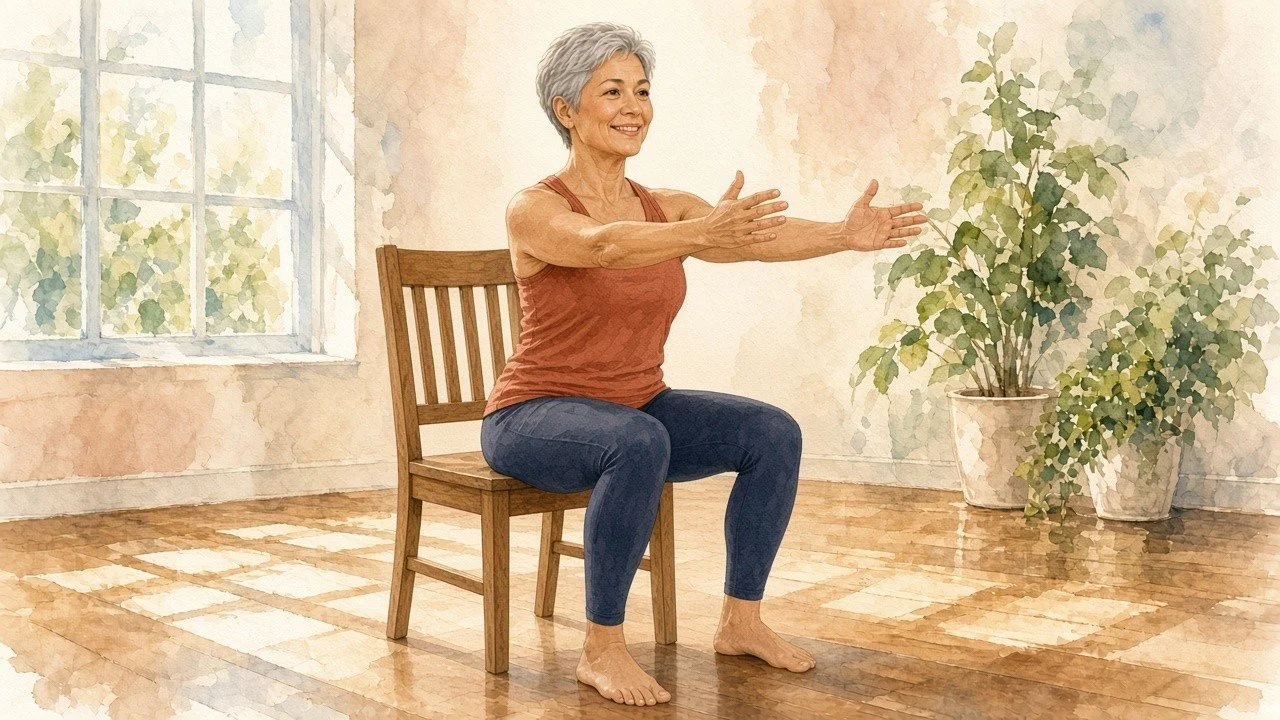
- Two or three days this week, practice a slow sit-to-stand from a sturdy chair. Reach your arms forward if you like, use your legs, and stand all the way tall. Sit down with control. Start with a number that feels doable.
- If you already walk, keep your usual walks, and notice whether a slightly brisker pace feels comfortable for a few minutes in the middle.
- Add one short strength session you can do from a chair, such as seated rows with a light resistance band or light dumbbells, or seated marches. Stop if anything feels sharp or unsafe.
- Pick one extra way to notice progress this week, besides a single number: stairs, getting out of the car, carrying groceries, or how steady you feel when you stand up.
- If you are starting something new, or you live with health conditions, check in with your doctor first, and ask a qualified teacher to watch your form.
This post is for general education and is not personal medical advice. If you have health conditions, balance concerns, or questions about starting or changing an exercise program, talk with your clinician before you do.