Healing Joints: How to Actually Rebuild Them

This article is a summary of the wonderful conversation between Professor Keith Baar from UC Davis and Dr. Yaad. Watch the whole thing here: https://youtu.be/MI54xRlHTjU?si=zl6Zgzn2UkogQ8Z9
Or watch the interview with Tim Ferris
If you’ve ever had aching knees, cranky shoulders, or wrists that complain every time you push yourself up off the floor, you’ve probably heard the advice: “Just rest.”
Here’s the truth: rest alone doesn’t heal your joints. In fact, prolonged rest can make things worse. The good news? There’s a simple, science-based way to get your joints stronger and more resilient — even if you’re not a hardcore athlete.
Let’s unpack how your joints actually work and then walk through a simple daily protocol you can start today.
🧬 How Joints Get Nutrients

Joints need to move to get nutrients into the joint.
Unlike your muscles, tendons, ligaments, and cartilage don’t have their own blood supply. They rely on a mechanical process to get nutrients in and waste out:
When you load a tendon or compress cartilage, you literally squeeze fluid out.
When you unload, new nutrient-rich fluid is drawn back in.
Think of it like a sponge in a sink. If you leave the sponge alone, nothing moves. If you gently squeeze and release, fresh water flows in. This is why gentle movement and loading are essential for joint health — it’s how your body delivers nutrition to those tissues.
😴 Why Rest Alone Doesn’t Work
When you immobilize a joint (say you’re sick in bed or nursing an injury) for just 3–7 days, your tendons can lose 15–20% of their collagen…. That’s the stuff that gives them strength and structure.
Rebuilding that loss takes up to 8 weeks. So every time you “rest it out” for a week, you’re actually setting your tissues back — unless you reintroduce smart, progressive loading.
🧱 Why You Don’t Need “More Load” to Heal
For years, many of us believed that to make connective tissue stronger, we had to add more load over time, like progressive weight training. The research says otherwise:
In lab studies, tendons got their maximum growth signal within the first 10 minutes of gentle loading. After that, the stimulus plateaus — you’re not helping anymore, you’re just adding wear and tear….
Four short isometric holds (think holding a position without moving) gave a stronger signal for collagen synthesis than long dynamic workouts….
Doing two short, light sessions a day, separated by 6 hours, created double the collagen increase compared to one long session….
More isn’t better. Smarter is better.
⚡ The Real Enemy: “Jerk”
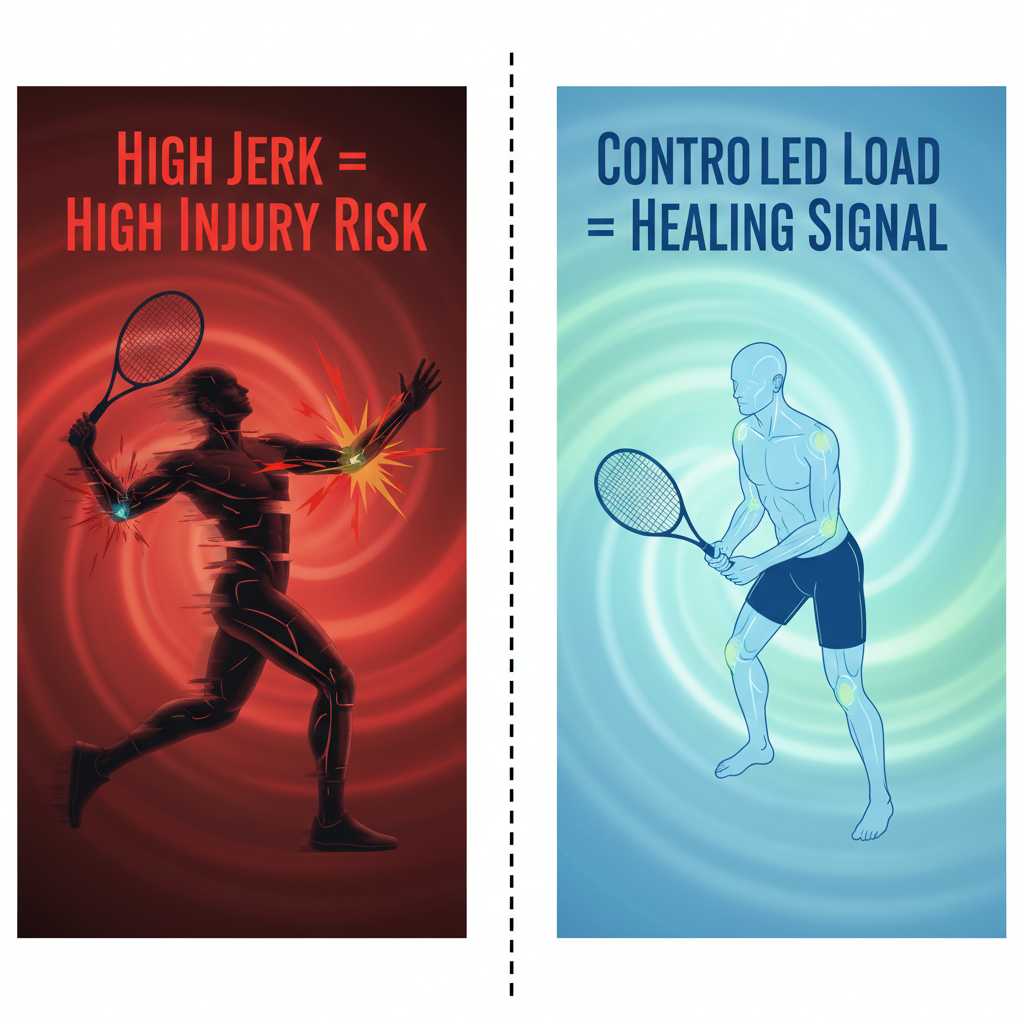
The Jerk is the real danger zone
Most joint injuries don’t come from holding positions — they come from jerky, high-acceleration movements. “Jerk” is the sudden snap in direction or load, like changing directions quickly, bouncing out of a squat, or swinging a tennis racket.,
High jerk = high injury risk. So when healing joints, slow, controlled, isometric work is your friend.
📝 The Healing Joints Protocol
Here’s a simple, evidence-based daily routine to strengthen and heal your tendons and ligaments. This works for knees, wrists, elbows, and shoulders — just adapt the position.
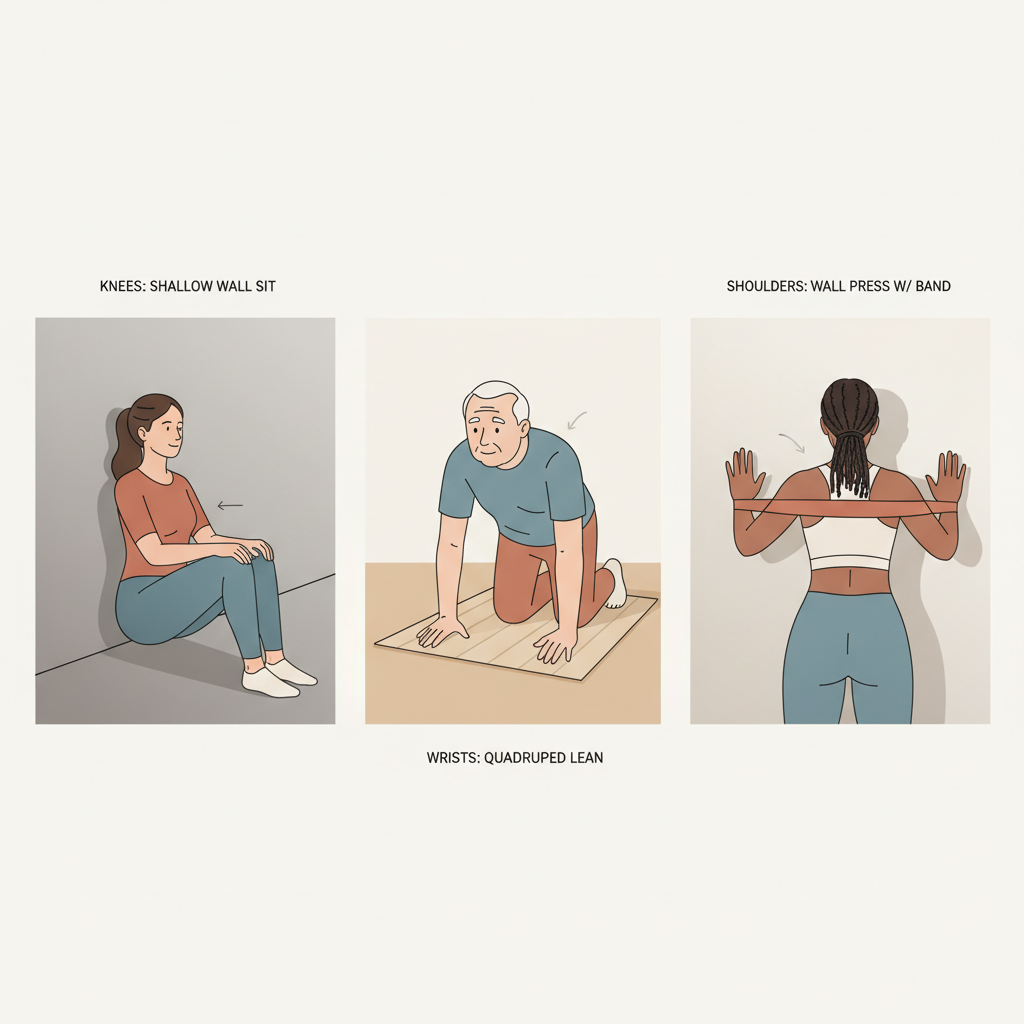
Isometric holds help rebuild your joints
Step 1: Pick Your Position
Choose a position that gently loads the affected joint without pain. Examples:
Knees: shallow wall sit or mini squat hold
Wrists: light quadruped lean or plank on elevated surface
Shoulders: light isometric hold with resistance band or doorway press
👉 Start with ~40% of your max load. It should feel like a firm, comfortable tension — not pain.
Step 2: Hold for 30 Seconds
Hold the position without moving for 30 seconds. Breathe. Stay relaxed. Don’t bounce or shift.
Repeat for 10 minutes, with a 30-second rest between holds.
Step 3: Do It Twice a Day
For best results, do this once in the morning and once later in the day, separated by at least 6 hours. This creates two strong “anabolic” (growth) signals in the tissue each day without overloading it.
Step 4: Keep It Light and Consistent
The goal is gentle, consistent loading, not max effort. You don’t need to add more weight each week. Over time, as pain decreases and your holds feel easier, you can adjust:
Slightly deeper position
Slightly longer hold (up to 45 sec)
Slightly more load — but never to pain.
Step 5: Be Patient — But Know It Works
Collagen remodeling takes time. 8–12 weeks is a realistic window to see significant strength improvements in tendons. But many people feel reduced pain and better function within a couple of weeks when they stay consistent.
🚫 What Not to Do
❌ Don’t just rest for weeks — you’ll lose collagen fast.
❌ Don’t chase soreness. Tendons don’t give you the same “DOMS” feedback muscles do.
❌ Don’t add dynamic, jerky moves early in the healing process.
❌ Don’t assume “heavier = better.” The stimulus plateaus fast.
✨ In Summary
Healing your joints isn’t about smashing them with weight or babying them into weakness. It’s about giving your connective tissues the exact kind of loading they’re designed to respond to:
Short isometrics
Gentle tension
Repeated twice daily
Over weeks, not days
With this approach, you’re not just reducing pain — you’re rebuilding the structure of your joints from the inside out.